Tuesday, April 18, 2023

'Scent of a Woman' review, Jan. 8, 1993


By 
DONALD PORTER

Standard-Examiner staff 

In the course of living, we inevitably encounter people who are so persistently obnoxious that we go to great lengths to avoid them. Al Pacino plays just such a jerk in “Scent of a Woman.” But we’re supposed to pay good money to spend more than two hours with him. 

It’s the same sort of bizarre miscalculation director-star Billy Crystal made with last year’s “Mr. Saturday Night,” which also was a movie about a jerk. 

There are some people you just don’t want to spend a couple of hours with. As cinematic torture goes, there are worse movies to punish yourself with (“Toys,” for example). Still, “Scent of a Woman” is not the only other movie in the marketplace.

Pacino plays Frank Slade, a former military man whose loud, boorish behavior worked fine for him while he was on LBJ’s White House staff a quarter century ago – LBJ, after all, was probably worse than Slade in the crude department. But somewhere along the line Frank’s career derailed, and he wound up playing hot potato with live hand grenades to relieve boredom, or prove his mettle, or whatever. The stunt blinded him, and he’s been living on a disability pension ever since. 

Bottom line: Frank’s life, as he views it, isn’t much fun anymore. He’s been living with his niece, her husband and their two kids – and hating every moment. Now’s his chance to make a break for it: They’re leaving home for the weekend and have hired a teenager, Charlie (Chris O'Donnell), to look after him. 

Unbeknownst to everyone, Frank’s been stashing his pension checks away, saving for a big trip to New York City. He hauls Charlie along, of course, and once in the city they eat the best food, drink the best liquor and Frank spends time with the best call girl. 

Inevitably, the two males wind up teaching each other about life over the course of their eventful weekend. 

Regrettably, the one major plot twist that’s supposed to take us by surprise is shockingly easy to anticipate – a flub that further deflates the movie. (I won’t reveal it, but rest assured that if you see the film you’ll catch on early.) After that, all that’s left is to watch Pacino slam dunk all the other actors who venture into the frame alongside him. 

The man can act ... with a vengeance. There, hasn’t been this much acting going on in a movie since Dustin Hoffman wore a skirt in “Tootsie.” It’s a shameless play for Oscar consideration, a big bold “Look, Ma, I still have what it takes!” message for a Hollywood currently obsessed with younger talent.

The thing that makes you cringe is the knowledge that, yes, Pacino has talent to spare; he really is the genuine article, one of our best actors. It’s precisely his ability to remain truthful to the character of Frank Slade that does the movie in: Frank is so easy to dislike that we stop caring precisely when we should be caring the most. Frank’s a goon.

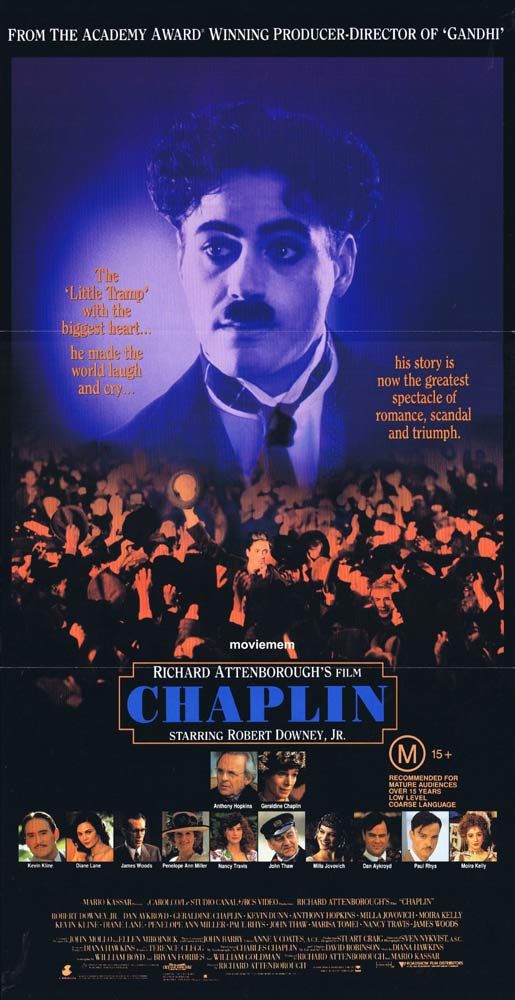
"Chaplin" review from Jan. 8, 1993


‘Chaplin’ offerlittle new 

By DONALD PORTER
Standard-Examiner staff 

The equivalent of a Reader's Digest Condensed Version of Charles Chaplin's life opens in movie theaters today under the title “Chaplin.” It’s adequate, but by no means revealing – or, for that matter, perceptive. 

After all, Chaplin’s career – as an actor first, and director-star later on – was marked by a series of ground-breaking, hilarious films. He was consistently good at what he did.

And while “Chaplin” gives us an inkling of the filmmaker’s obsessional perfectionism, it seems more preoccupied with detailing his many affairs with underage and/or overwrought females. Director Richard Attenborough (“Gandhi”) displays an eerie fascination with the breasts of his actresses; as a result, you walk away from “Chaplin” thinking the filmmaker may have been a genius, yes, but he was also a leering, dirty old man. 

Chaplin is played by Robert Downey, Jr. (“Less Than Zero”), who displays an impressive talent for physical mimicry. Furthermore, he captures –insofar as the shallow script allows – the frustration, self-doubt and ego that made Chaplin the man he was. 

Born and raised in England, Chaplin was a child of poverty whose mother (Geraldine Chaplin, who plays her own grandmother here) was mentally ill. Chaplin began on the vaudeville stage, and was summoned to Hollywood by comedy director Mack Sennett. He was a natural, and before too many years had passed, was running his own studio and making his own movies – the most popular comedian in the world.

But Chaplin's personal life was a disaster, as friends like Douglas Fairbanks (Kevin Kline) were wont to point out. Chaplin only seemed to settle down late in life, when his physical decline slowed his randy impulses. 

Aside from Downey’s marvelous performance, there are a few surprises. For instance, did you know that Chaplin hid away in a Salt Lake City hotel to edit “The Kid,” so as to avoid having the movie seized in a bitter divorce battle? Or that he apparently saw his first movie in Butte, Mont.? Or that he insulted J. Edgar Hoover at a dinner party years before Hoover headed the FBI, and that apparently Hoover’s vendetta against Chaplin – which eventually resulted in the filmmaker's exile in Switzerland – arose from that incident?

Attenborough also manages to restore some luster to Fairbanks’ reputation by way of Chaplin’s continual praises. And the judicious use of clips from actual Chaplin films serves to validate the film’s reason for being: Charlie Chaplin was the best at what he did, despite the shambles of his personal life.


Saturday, April 4, 2015

Stevenson plunges in- again – after ‘M*A*S*H’

From the Standard-Examiner, published sometime in 1985:

By DONALD PORTER
Standard-Examiner staff

McLean Stevenson in "M*A*S*H" (credit: IMDB.com)
SALT LAKE CITY - McLean Stevenson had been on the road for days, hyping his new show "America." His suits were rumpled, he was tired and irritable. It was only 10:30 a.m., but be had been speaking to groups of journalists and potential advertisers for several hours.
 
Finally, the man who gained fame in the role of Lt. Col. Henry Blake on “M*A*S*H” was taking a break, eating breakfast and making small talk with KSL-TV newscasters Shelley Thomas and Dick Nourse.
 
The laughter and chatter came to a sudden halt when his publicist appeared at the table, reminding him it was time for another interview.

Friday, August 9, 2013

“The Sandlot” interviews, April 9, 1993

By DONALD PORTER
Standard-Examiner staff


Renna
SALT LAKE CITY -- Patrick Renna and Chauncey Leopardi, two youthful co-stars of "The Sandlot," are sitting in a suite at the Hilton Hotel, attempting to verbalize their feelings about acting in the movie. It's a nostalgic kiddie-baseball fantasy, very much in the vein of the vintage "Our Gang" series.

Renna, a husky 14-year-old, plays Ham, the team's slugger and chief trash-talker. Leopardi, 11, plays Squints, a bespectacled half-pint with a taste for older, buxom women.


Sunday, April 7, 2013

Penelope Spheeris, Jan. 18, 1991

By DONALD PORTER
Standard-Examiner staff

For the past year or two, filmmaker Penelope Spheeris has been smack-dab in the middle of it.

She spent a year working as a story editor on the TV sitcom "Roseanne," then segued into a gig as director of the rap band 2 Live Crew's long-form video, "Banned in the U.S.A." It's as though she went mining for showbiz controversy and struck the mother lode.

Of her experience on "Roseanne," a TV series now legendary for battles between writers, producers and stars, Spheeris likens it to "having a belated Hollywood boot camp. It was pretty horrendous."

And the matter of her touring with and filming 2 Live Crew, the music industry's bad boys? Well, we'll get to that later.

First of all, who is this Penelope Spheeris, anyway?

Saturday, April 6, 2013

Altman's angles put off studios, Jan. 18, 1991

By DONALD PORTER
Standard-Examiner staff

Robert Altman is on the phone from his office in Los Angeles, laughing ruefully that many journalists are labeling "Vincent and Theo," his new film, a "'comeback."

"I wish I could make a comeback," he says. "At first, I resented that by saying, 'Jeez, I haven't been anywhere.' But now I have no work. I'd like to make a comeback, whatever that means."

The currently unemployed film director will be attending the Sundance Film Festival, running today through Jan. 27 in Park City, in conjunction with a six-film retrospective of his work, and to host the regional premiere of "Vincent and Theo" at 7 p.m. Thursday in Park City's Egyptian Theater. The new film is his look at the relationship between painter Vincent van Gogh and his brother, Theo, who supported the artist's nine-year career.

Tuesday, February 19, 2013

Patrick Bergin, "Mountains of the Moon," March 9, 1990

Patrick Bergin in "Mountains of the Moon"
By DONALD PORTER
Standard-Examiner


For Patrick Bergin, star of the new film "Mountains of the Moon," the glamor part of movie stardom took a little time to kick in. When he was shooting the film in Kenya, the experience was anything but. There's nothing particularly romantic about having lions thrown at you.

"Having a quarter of a ton of lion thrown on top of me was pretty fantastic and lousy at the same time," he says, laughing. "It certainly nearly killed me."

The scene involved his character, 19th century writer and adventurer Richard Burton, being chased and attacked by a male lion. Fortunately for Burton, the beast was fatally wounded as it leaped through the air at him.